

Who Are the Top LED Panel Light Manufacturers in China?
I can write the introduction, but no source article or verifiable expert quotation was provided. To avoid inventing a person’s credentials or words, please share the expert’s name and quote—or provide an article I can use as a source.
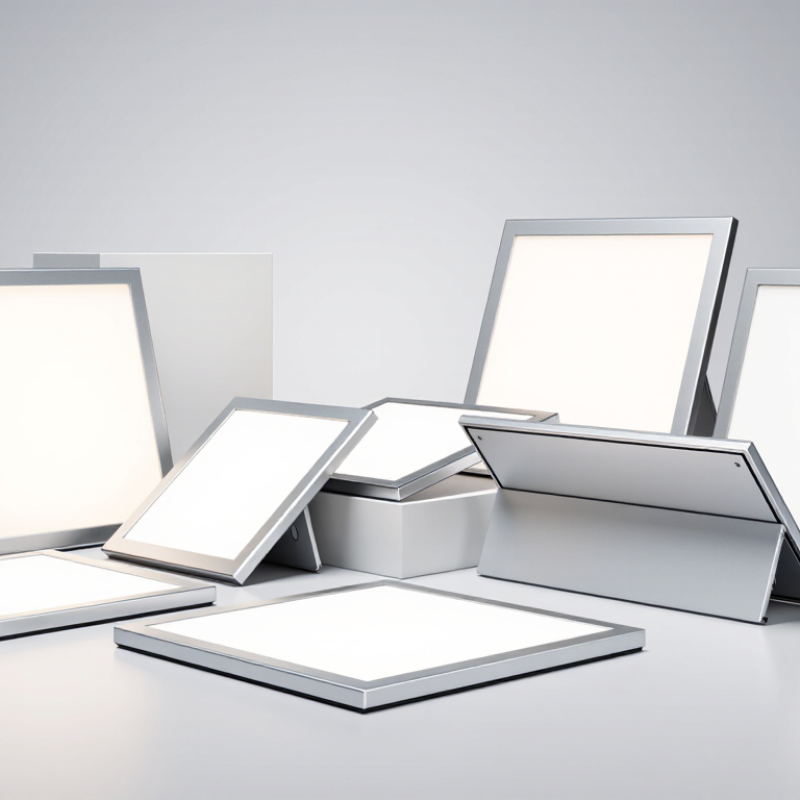
What LED Panel Lights Are and How They Work
LED panel lights are flat luminaires designed to spread light across a broad surface. Inside, semiconductor chips convert electrical energy into light through electroluminescence. A driver regulates incoming power, while a diffuser softens bright points and reduces glare. In edge-lit designs, LEDs send light through a light-guide plate; back-lit panels place LEDs behind the diffuser. The result is a slim fixture suited to offices, classrooms, and other spaces needing even illumination. Not magic.
Light quality depends on more than the panel’s appearance. Chip layout, diffuser materials, driver performance, and heat management all affect brightness and service life. The U.S. Department of Energy’s Energy Saver guidance reports that LEDs use at least 75% less energy and last up to 25 times longer than incandescent lighting. That comparison is not a panel-specific guarantee; actual performance varies by product and use. It is tempting to assume every flat panel performs alike. That deserves a second look.
Tip: Check the rated lumens, color temperature, color-rendering index, and flicker information before comparing models. For a real installation, test the panel in the room: cool, uniform light can still feel harsh on a glossy desk. The specification sheet helps, but it cannot fully predict how the space will feel.
Who Are the Top LED Panel Light Manufacturers in China? - What LED Panel Lights Are and How They Work
| Category | Dimension or Component | Factual Overview | Practical Consideration |
|---|---|---|---|
| Product definition | LED panel light | A thin, broad-area luminaire that uses light-emitting diodes (LEDs) and optical layers to produce relatively even illumination across a flat surface. | Commonly used in offices, schools, healthcare settings, and other indoor spaces. |
| Light source | LED chips or LED packages | When forward current passes through an LED semiconductor, it emits light through electroluminescence. The LED arrangement and optical design influence brightness and uniformity. | LED layout, thermal management, and component quality affect performance and service life. |
| Optical design | Edge-lit construction | LEDs are positioned around the panel’s edges. A light-guide plate distributes their light across the panel, while diffuser layers help create a uniform output. | Often used where a slim profile is desirable; uniformity depends on the optical design. |
| Optical design | Back-lit construction | LEDs are arranged behind the emitting surface. Diffusers and other optical materials help blend the light into an even panel output. | Panel depth and light distribution vary by design and product model. |
| Power control | LED driver | The driver converts incoming electrical power into regulated current suitable for the LEDs. Some drivers also support dimming or control interfaces. | Check input-voltage compatibility and dimming method against the building’s electrical system. |
| Common format | 600 × 600 mm (nominal) | A widely used metric ceiling-panel format. Actual product dimensions can differ slightly to suit the mounting system. | Confirm ceiling-grid dimensions and installation requirements before ordering. |
| Common format | 600 × 1200 mm (nominal) | A rectangular metric format used in some suspended-ceiling layouts; exact dimensions depend on the product and market. | Check the ceiling system, cut-out, and support method for compatibility. |
| Common format | 2 × 2 ft and 2 × 4 ft (nominal) | Common nominal panel formats in North American commercial lighting. Nominal dimensions refer to the ceiling-grid format, not necessarily the exact fixture size. | Verify the fixture’s actual dimensions and mounting details for the specific ceiling grid. |
| Light quality | Correlated color temperature (CCT) | CCT, measured in kelvins (K), describes whether white light appears warmer or cooler. A lower value appears warmer; a higher value appears cooler. | Compare the specified CCT with the intended space and existing lighting. |
| Performance measure | Luminous efficacy | Measured in lumens per watt (lm/W), this indicates how much luminous flux a luminaire produces for each watt of electrical input. | Compare tested luminaire-level figures, rather than relying only on LED-chip efficacy or wattage. |
| Manufacturer evaluation | Documentation and quality control | Relevant checks include product datasheets, photometric test reports, electrical and safety documentation, warranty terms, and production quality-control procedures. | Request documentation for the exact model and destination market; requirements differ by application and jurisdiction. |
Related Posts
-
Understanding the Benefits of Energy Efficient Led Panel Light for Modern Workspaces
-
How to Choose the Best Light Panel for Your Business
-
10 Reasons Why Best Led Panel Light is the Ultimate Choice for Global Buyers
-

Understanding the Types of LED Panel Lights: A Comprehensive Guide
-

How to Choose the Right LED Panel Light for Your Home or Office Needs
-
Overcoming Common Issues with Best LED Ceiling Panels for Global Buyers