How to Choose the Best Light Panel for Your Business
Choosing a Light Panel is not simply a matter of comparing brightness or price. In a shop, office, clinic, or workshop, the wrong panel can create glare, uneven color, or dark patches over work surfaces. The right one should suit the room, the task, and the hours the lights stay on. Small details matter.
The U.S. Department of Energy’s Energy Saver guidance states that LED products use at least 75% less energy and can last up to 25 times longer than incandescent lighting. These figures describe LEDs generally, not every Light Panel or installation. Still, they show why efficiency and rated lifetime deserve attention alongside purchase cost. Check the product’s lumen output, color temperature, color rendering index, dimming compatibility, and warranty. A bright panel can still make labels, food, or skin tones look wrong.
Professional lighting practice also considers glare, mounting height, spacing, and the work being performed. A specification sheet helps, but it cannot reveal every issue in your actual space. Ask suppliers for photometric files or a layout based on measured room dimensions, then test a sample panel where possible. Observe it at opening time and during the busiest shift. That is where surprises show up. This guide explains how to compare panel types, assess operating costs, and match performance to business needs. One caveat: projected savings depend on existing fixtures, usage, controls, and local energy rates. A careful choice begins with measurements, not marketing claims.
Understand Light Panel Types and Their Business Uses
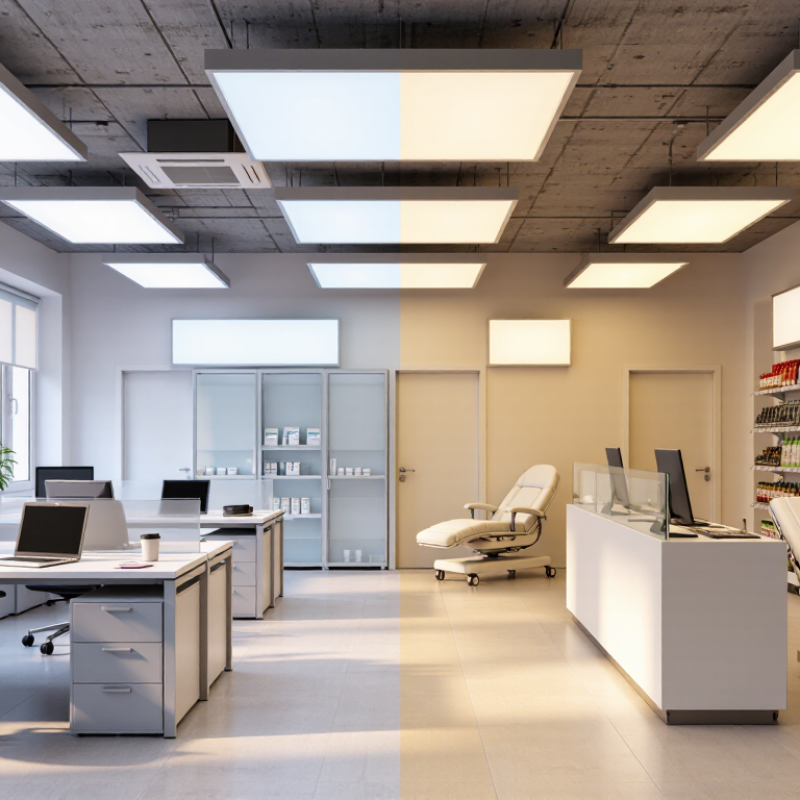
Light panels differ in construction and purpose. Edge-lit panels place LEDs around the frame, sending light through a diffuser. Their slim profile suits offices with shallow ceiling cavities and open desks. Back-lit panels position LEDs behind the diffuser, often making output more consistent at higher brightness levels. They can work well in retail areas where products need clear, even illumination. Neither type is automatically better. Check measured output, glare control, and ceiling compatibility.
Controls matter, too. Dimmable or tunable-white panels can support meeting rooms that shift from presentations to focused work. In studios, adjustable color temperature helps keep product images consistent. The U.S. Department of Energy reports that LEDs use at least 75% less energy and last up to 25 times longer than incandescent lighting; actual savings depend on the fixture and operating hours. A panel’s label alone won’t predict comfort. Compare light output and color quality, then test a sample in the real space. A cold-looking conference room can still feel wrong. One easy-to-miss detail: confirm whether the driver is compatible with existing dimmers before ordering.
Define Your Lighting Needs and Installation Environment
Start with the tasks people perform, not the panel specifications. A retail counter needs clear color and comfortable light for long shifts. An inspection bench may need more even illumination across small details. Measure the space first. Note its length, ceiling height, and the locations of shelves or equipment. Then estimate how bright the work surface needs to be; a lighting professional can help verify levels for demanding tasks. Consider color rendering and color temperature, too. They affect how products, materials, and printed labels appear.
The installation environment can rule out unsuitable panels. Check whether the ceiling is suspended, concrete, or already fitted with recessed fixtures. Confirm available power, mounting depth, and access for future cleaning or repairs. In a kitchen or dusty workshop, review the panel’s protection rating and the manufacturer’s stated operating conditions. Also look for glare on glossy counters and computer screens. A careful survey can still miss a reflection at working height, so inspect the room from where employees actually stand or sit. It is tempting to choose a panel from a tidy specification sheet alone; real rooms are less tidy. Before ordering several units, test one in the space and reassess brightness, color, and comfort during normal working hours.
How to Choose the Best Light Panel for Your Business
Define Your Lighting Needs and Installation Environment
Typical maintained illuminance targets vary by task and local standards. Use them as a starting point when selecting panel output; also consider mounting height, room reflectance, glare, and moisture or dust exposure. Confirm requirements against applicable regulations and a site-specific lighting plan.
Compare Brightness, Color Quality, and Energy Efficiency
How to Choose the Best Light Panel for Your Business
Compare brightness, color quality, and energy use in the space where the panel will operate. Lumens describe total light output; lux measures light reaching a surface. A panel may look bright in a showroom but leave a workbench dim once installed. Check fixture spacing, ceiling height, and the task area before comparing products. For color, review the Color Rendering Index (CRI), then inspect real materials under the light. A printed color chart can reveal differences that specifications miss. IES guidance treats lighting needs as task-dependent, so one brightness level rarely suits every room.
Energy efficiency matters over years of daily use. The U.S. Department of Energy reports that LED lighting uses at least 75% less energy and can last up to 25 times longer than incandescent lighting. That comparison is not a guarantee for every panel; compare tested wattage, lumen output, and warranty details. Also check whether dimming controls work smoothly. A panel that flickers at low settings can undermine an otherwise sensible purchase. Specifications help, but they do not replace an on-site trial.
Tips: Request photometric test data, such as LM-79 results, and compare delivered lumens per watt. Test panels over your actual counter or display for a few days. Note glare, color shifts, and shadows. I would not choose by CRI alone; it is useful, but it cannot capture every preference or viewing condition. A small trial may expose an awkward mismatch before you outfit the whole space.
How to Choose the Best Light Panel for Your Business - Compare Brightness, Color Quality, and Energy Efficiency
| Panel Type |
Typical Fixture Output |
Representative Power |
Approx. Efficacy |
Typical CRI |
Common Color Temperature |
Estimated Annual Energy Cost |
Best Suited For |
| Fluorescent troffer |
About 4,000 lm |
72 W |
About 56 lm/W |
Usually 80–85 |
3500–5000 K |
About $43.20 |
Existing fluorescent installations where replacement cost is the main concern |
| Edge-lit LED panel |
About 4,500 lm |
36 W |
About 125 lm/W |
Usually 80–90 |
3000–5000 K |
About $21.60 |
Offices and classrooms needing a slim, evenly lit ceiling panel |
| Backlit LED panel |
About 5,000 lm |
40 W |
About 125 lm/W |
Usually 80–90 |
3000–5000 K |
About $24.00 |
Retail, healthcare, and other spaces that benefit from higher light output |
| Tunable-white LED panel |
About 4,500 lm |
42 W |
About 107 lm/W |
Usually 80–90 |
Adjustable, commonly 2700–6500 K |
About $25.20 |
Multi-use workplaces that need adjustable warm-to-cool lighting |
Figures are representative benchmarks for common 2 × 4 ft ceiling fixtures, not product guarantees. Annual energy cost assumes 4,000 operating hours per year and an electricity rate of $0.15 per kWh; it excludes installation, maintenance, and demand charges. CRI (Color Rendering Index) indicates how accurately colors appear under the light. Actual room brightness depends on fixture layout, ceiling height, and surface reflectance.
Assess Durability, Controls, and Maintenance Requirements
A light panel in a busy shop faces more than long hours. Dust, warm air, and frequent cleaning can wear down its housing and diffuser. Check that the frame feels rigid, seams are closed, and mounting points suit your ceiling or work surface. Ask for the rated operating life and warranty terms, but treat them as guidance, not a promise. Real conditions vary. A panel near a hot kitchen may age differently from one in a quiet office.
Controls should make daily adjustments simple. Test the dimmer across its full range and check whether brightness changes smoothly without flicker. If staff use switches, make sure their labels are clear and the controls are easy to reach. Maintenance matters, too. Look for accessible surfaces and replaceable components, and confirm how power must be isolated before cleaning or service. A tool-free cover sounds convenient, though it may not be the best choice if it feels loose. I would inspect that detail in person.
Tips: Ask who handles repairs and how quickly replacement parts are available. Wipe a sample panel with your usual cleaning cloth. Check the diffuser afterward for streaks or scratches. Small tests help reveal issues a specification sheet cannot.
Match Your Budget to the Right Panel Specifications
A light panel should fit both your budget and the work happening beneath it. Start by measuring the ceiling space and identifying what staff need to see clearly. A reception desk may need even, comfortable light, while a workshop bench may require brighter, focused illumination. Check brightness, panel size, color quality, dimming options, and energy use. A low purchase price can look attractive, but replacement labor and power costs matter too. Small details count.
Compare specifications against the room, not just the product sheet. For color-critical tasks, such as inspecting fabric or food, look for a strong color rendering index. In a quiet office, glare control and adjustable brightness may matter more than maximum output. Ask about expected service life and warranty terms, then compare those costs over several years. There is no perfect specification. A panel chosen for a showroom may feel harsh in a small meeting room, so reconsider the choice after testing one in place.
Tips: Measure the ceiling grid, estimate daily operating hours, and request a sample when possible. Check the light at desk height. It may look different installed.