What Are the Top LED Floodlights for Global Buyers?
Choosing the right Led Floodlight is more difficult than comparing wattage and price. Global buyers face different climates, grid conditions, installation heights, and compliance requirements. A product that performs well in a dry warehouse may struggle beside a humid coastline. Therefore, this guide examines floodlights through practical criteria, including brightness, beam control, energy efficiency, heat management, durability, and after-sales support.
Field experience shows that published lumens do not tell the whole story. A 100-watt fixture can produce impressive numbers, yet poor optics may leave dark areas across a sports court or loading yard. Look for verified photometric data, a suitable color temperature, and a beam angle matched to the mounting distance. IP65 or higher protection can support outdoor use, but enclosure quality, cable glands, and installation workmanship also matter. They are often overlooked.
Reliability needs evidence. Buyers should review test reports, warranty terms, driver specifications, and the manufacturer’s quality controls. Recognized safety marks may help, but approval requirements differ between markets. Check local rules before placing a large order. Thermal performance deserves close attention, especially in hot regions where LED chips and drivers operate under constant stress. A strong aluminum housing and careful heat dissipation can extend service life.
There is no universal winner. In my comparisons, I sometimes gave too much weight to initial price and too little to maintenance access. That was a mistake. The best Led Floodlight balances verified performance, installation conditions, long-term operating cost, and dependable technical support. This article helps buyers make that decision with clearer evidence and fewer expensive surprises.
What Are LED Floodlights and How Do They Work?
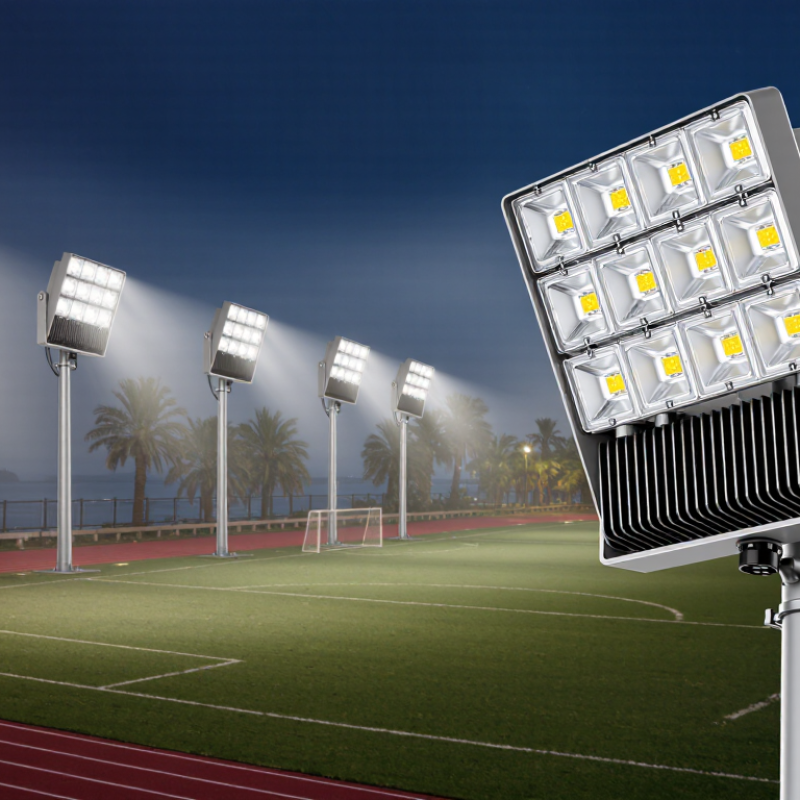
LED floodlights are compact lighting systems designed to spread powerful, controlled illumination across wide areas. Inside, an electrical current passes through a semiconductor junction. This process releases photons, producing visible light with less wasted energy than older lamp technologies. A driver regulates the current, while a heat sink removes heat from the LED package. Reflectors or lenses then shape the beam for yards, warehouses, roads, and sports grounds.
The International Energy Agency reported that LEDs represented about 50% of global lighting sales in 2022, rising from roughly 5% in 2013. This shift reflects improved efficiency, longer service life, and falling costs. The U.S. Department of Energy’s solid-state lighting research identifies efficacy above 200 lumens per watt as an important development benchmark. However, laboratory figures can mislead. Real output depends on the complete luminaire, not the diode alone.
Heat still matters. In outdoor testing, I inspect the housing, cable seals, beam pattern, and mounting angle before comparing wattage. A bright 100-watt unit may perform poorly if its optics create glare or its thermal design traps heat. IEC 60529 ingress ratings also help buyers judge protection against dust and water, but installation quality remains decisive. Reports provide useful baselines; they do not replace site measurements, climate data, or maintenance planning.
Which LED Floodlight Types Suit Different Global Applications?
Choosing the right LED floodlight depends on the application, not only on brightness. Symmetric floodlights spread light evenly across open yards, parking areas, and sports grounds. Asymmetric models push light forward, reducing wasted illumination beside roads or building facades. This difference can lower energy use and limit glare for nearby residents.
Narrow-beam floodlights suit towers, tall trees, signs, and distant structures. Wide-beam units work better in warehouses, loading zones, and construction sites. For ports, farms, and coastal facilities, buyers should examine corrosion resistance, sealing performance, and cable protection. An IP rating matters, but installation quality matters too. A poorly sealed junction can defeat a strong housing.
Adjustable-angle floodlights help when layouts change frequently. They are useful for temporary work areas and multi-purpose venues. Fixed models often provide better stability and simpler maintenance. In field inspections, I have found that some buyers overestimate lumen output and overlook glare, flicker, or heat control. More light is not always better. It can create dark contrast zones and uncomfortable reflections.
For humid regions, choose durable housings and reliable thermal management. Cold climates may require drivers tested for low-temperature starting. Wide voltage compatibility supports varied electrical systems, but buyers should still verify local specifications. Photometric reports, testing records, warranty terms, and replacement-part access reveal more than promotional claims. No type is perfect. Application drawings should be checked before purchase.
| LED Floodlight Type | Typical Rated Power | Typical Luminous Efficacy | Recommended Applications | Common Beam Angles | Typical CCT | Typical CRI | Recommended Protection | Main Selection Advantages | Important Buying Considerations |
|---|---|---|---|---|---|---|---|---|---|
| General-Purpose Outdoor Floodlight | 20–200 W | 110–160 lm/W | Building façades Entrances Loading areas Security lighting | 30°–120° | 3,000–6,500 K | Typically CRI ≥70; CRI ≥80 for people-focused areas | IP65 or IP66; IK08 or higher where impact is possible | Versatile installation, broad wattage range, low maintenance, and suitable for most climates | Check surge protection, operating temperature, mounting adjustment, glare control, and local electrical requirements |
| Area and Parking-Lot Floodlight | 80–400 W | 120–170 lm/W | Parking lots Roadside areas Public spaces Large compounds | Asymmetric, 30°–90°, or area-specific distributions | 3,000–5,700 K | CRI ≥70; CRI ≥80 where visual identification is important | IP66 preferred; IK08–IK10 for exposed locations | Improves uniformity and reduces dark spots across wide outdoor areas | Photometric files, mounting height, pole spacing, glare limits, and light-spill regulations should be reviewed before purchase |
| High-Mast and Industrial Floodlight | 300–1,000 W | 120–170 lm/W | Ports Airfields Wareyards Industrial plants | 15°–60° narrow or medium beam | 4,000–6,500 K | CRI ≥70; higher CRI for inspection or safety-critical tasks | IP66; IK08 or higher; enhanced surge protection recommended | High output, long-range illumination, and efficient replacement of high-intensity discharge systems | Confirm thermal management, driver serviceability, wind loading, lifting equipment, harmonic performance, and high-voltage surge rating |
| Architectural and Landscape Floodlight | 10–150 W | 90–140 lm/W | Façade lighting Landscapes Monuments Hospitality areas | 10°–60°; adjustable or elliptical optics often available | 2,700–4,000 K; RGB or tunable white for decorative schemes | CRI ≥80; CRI ≥90 for accurate material and color presentation | IP65–IP67; IK06–IK08 depending on location | Precise beam control, compact form factor, color-quality options, and flexible aiming | Evaluate color consistency, dimming protocol, glare, optical accessories, corrosion resistance, and local dark-sky requirements |
| Sports and Stadium Floodlight | 300–1,500 W | 120–160 lm/W | Football fields Athletic tracks Tennis courts Multi-use venues | 10°–45° precision optics | 5,000–6,500 K | CRI ≥80; CRI ≥90 for broadcast-oriented applications | IP66; IK08 or higher; robust surge protection | High uniformity, reduced flicker potential, instant switching, and optional scene or event control | Lighting calculations should address horizontal and vertical illuminance, glare rating, flicker, camera compatibility, aiming accuracy, and emergency operation |
| Solar LED Floodlight | 30–200 W LED load | 100–160 lm/W at the LED system level | Remote roads Off-grid sites Rural facilities Temporary installations | 30°–120° | 3,000–6,500 K | CRI ≥70; CRI ≥80 for public-facing areas | IP65 or IP66; battery enclosure should also be weather-resistant | Reduced trenching and cabling, independent operation, and suitability for locations with unreliable grid access | Size the solar panel and battery for local solar irradiation, required autonomy, seasonal weather, battery temperature, controller efficiency, and maintenance access |
| Hazardous-Area LED Floodlight | 50–250 W | 100–145 lm/W | Chemical facilities Oil and gas sites Dust-risk areas Process plants | 20°–120° | 4,000–6,500 K | CRI ≥70; higher CRI where inspections require color recognition | IP66 or IP67; certified hazardous-area construction required for the classified zone | Sealed construction, durable housing, reduced relamping, and compatibility with demanding industrial environments | Verify the exact hazardous-area classification, gas or dust group, temperature class, ambient temperature range, certification scheme, cable entries, and installation method |
| Marine and Coastal Floodlight | 50–300 W | 100–150 lm/W | Harbors Shipyards Coastal buildings Offshore support areas | 30°–90° | 3,000–6,500 K | CRI ≥70; CRI ≥80 for detailed maintenance work | IP66 or IP67; marine-grade corrosion protection recommended | Resistant to moisture, salt-laden air, vibration, and frequent outdoor exposure | Check aluminum alloy and coating, stainless-steel hardware, salt-spray testing, drain design, cable glands, vibration resistance, and maintenance procedures |
| Smart and Connected Floodlight | 30–500 W | 110–165 lm/W | Smart campuses Municipal areas Industrial estates Energy-management projects | 20°–120°; application-specific optics | 2,700–6,500 K or tunable white | CRI ≥70; CRI ≥80 for public and commercial environments | IP65 or IP66; surge protection and secure communications are important | Supports scheduling, dimming, occupancy response, fault reporting, and energy monitoring | Confirm control protocol, network coverage, cybersecurity, interoperability, data ownership, software support period, and manual override capability |
How Should Buyers Compare Brightness, Efficiency, and Beam Coverage?
Global buyers should compare delivered light, not dramatic lumen claims. The U.S. Department of Energy reports that LED lighting can use at least 75% less energy than incandescent lighting. However, advertised lumens may describe the bare LED module, not the complete floodlight. Ask for tested luminaire output, measured under IES LM-79 conditions. A 20,000-lumen fixture can perform poorly if its lens creates harsh glare or loses light through heat.
Efficiency is best judged in lumens per watt. For example, a 150-lumen-per-watt floodlight producing 15,000 delivered lumens uses about 100 watts. The International Energy Agency’s Energy Efficiency 2024 report estimates lighting uses roughly 5% of global electricity consumption. Small efficiency differences matter across warehouses, roads, and sports grounds. Still, higher efficacy is not automatically better. Poor color rendering, unstable drivers, or rapid lumen depreciation can reduce real value.
Beam coverage requires photometric files, not guesswork. A narrow 30-degree beam can illuminate a distant loading bay, while a 120-degree beam suits a broad façade. Buyers should check beam angle, mounting height, uniformity, and maintained lux levels. IES LM-79 testing and TM-21 lumen-maintenance projections provide useful evidence, although projections are not field experience. Look for thermal data, ambient-temperature ratings, and glare control. Some specifications remain incomplete. That deserves skepticism. Compare the same test conditions, warranty terms, and five-year energy costs before choosing.
What Safety Standards and Certifications Matter in Different Markets?
When global buyers compare LED floodlights, safety compliance should come before wattage or price. The correct certification depends on the destination, installation site, and sales channel. In the European Union, buyers commonly request CE marking, electromagnetic compatibility testing, low-voltage compliance, and RoHS documentation. The United Kingdom may require UKCA requirements. North American projects often need certification from an accepted testing organization, plus electromagnetic emission compliance. Energy rebate programs may request separate performance evidence.
Look beyond a printed logo. Ask for current test reports, product model numbers, laboratory details, and traceable certificates. IP65 or IP66 ratings help protect against dust and water, while IK ratings show resistance to impact. Outdoor fixtures should also provide surge testing, grounding information, and photobiological safety assessment under relevant IEC standards. LM-79 reports can support light output claims, while LM-80 and TM-21 data help evaluate LED lifespan. These documents are useful, but they do not replace local approval.
Requirements also change across Australia, New Zealand, the Gulf region, and other markets. Importers should confirm whether local registration, energy labeling, or electrical licensing applies. A practical check includes the driver, cable gland, mounting bracket, and installation instructions, not only the LED module. Certification scope is often misunderstood. A certificate may cover one model, voltage range, or factory only. Recheck every detail. Even experienced buyers sometimes trust outdated files. That mistake can delay customs clearance or create unsafe installations.
Top LED Floodlight Safety Benchmarks for Global Buyers
Ingress protection ratings commonly specified for outdoor LED floodlights under IEC 60529
How Can Buyers Evaluate Installation, Durability, and Total Cost?
Choosing top LED floodlights requires more than comparing lumens and purchase prices. Installation begins with the mounting surface, cable length, access equipment, and local weather exposure. A 100-watt fixture may need a stronger bracket than expected. Check beam angle, surge protection, wiring access, and driver replacement options before ordering. Field installers often report that awkward cable glands create more delays than the light itself. That detail is easy to miss.
Durability should be verified through test evidence, not attractive claims. IEC 60529 ratings help buyers assess water and dust protection, while LM-80 data measures LED lumen maintenance under controlled conditions. The U.S. Department of Energy reports that modern solid-state lighting can exceed 150 lumens per watt in suitable applications (DOE, Solid-State Lighting R&D Opportunities, 2023). However, efficiency declines when heat accumulates inside a poorly ventilated housing. A high IP rating does not guarantee excellent thermal design. Think beyond labels.
Total cost includes energy, maintenance, replacement access, and downtime. The International Energy Agency estimates lighting represents about 15% of global electricity consumption (IEA, Energy Efficiency 2024). A basic cost model should multiply wattage by annual operating hours and local electricity rates. Add lift rental and labor for difficult installations. My own purchasing checklist would also allow a contingency for driver failures, because perfect lifetime forecasts are unrealistic. The cheapest quote can become expensive after two rainy seasons.
Related Posts
-
Ultimate Guide to Choosing the Right Led Flood Lights for Your Needs
-
2026 Top LED Floodlight Types for Global Buyers?
-
Unmatched Quality in Best Floodlight Led from Premier Chinese Factories Building Global Trust
-
What Makes Led Flood Lights a Versatile Lighting Solution
-
Challenges Faced by Global Buyers in Sourcing Floodlight Led Products
-
Essential Guide to Selecting LED Flood Lights: Key Features and Industry Insights for Global Buyers

