China Best Commercial LED Lighting Manufacturers?
Choosing among China’s best commercial LED lighting manufacturers requires more than comparing prices and product photos. Buyers need dependable performance, clear documentation, and evidence of consistent production. This guide examines how experienced purchasers evaluate Commercial Led Lighting suppliers for offices, retail stores, warehouses, hotels, and public facilities. It considers factory capability, product design, optical quality, energy efficiency, and after-sales support.
Real evaluation starts with details. Ask for current test reports. Review sample consistency. Check housing materials, driver brands, heat dissipation, and ingress protection ratings. A bright sample proves very little. The fitting must also maintain stable output after long operating hours. Experienced buyers may request a small trial order before approving large volumes. Factory audits, video inspections, and direct technical discussions can reveal differences that online catalogs hide. Certifications should match the destination market and the actual product model, not a similar item.
No supplier is perfect. Even strong manufacturers may have slow communication or limited customization experience. That matters. A reliable partner explains weaknesses instead of avoiding difficult questions. This article will compare practical selection factors, including manufacturing experience, engineering support, quality control, warranty terms, and delivery reliability. It will also highlight warning signs, such as vague specifications, copied product images, and unrealistic lifespan claims. Some conclusions may change after testing, because lighting performance depends on installation, temperature, controls, and maintenance. Careful judgment remains essential. The best manufacturer is not always the cheapest. It is the supplier that can repeatedly deliver safe, efficient, and suitable lighting for the project’s real conditions.
What Defines a Leading Commercial LED Lighting Manufacturer in China?
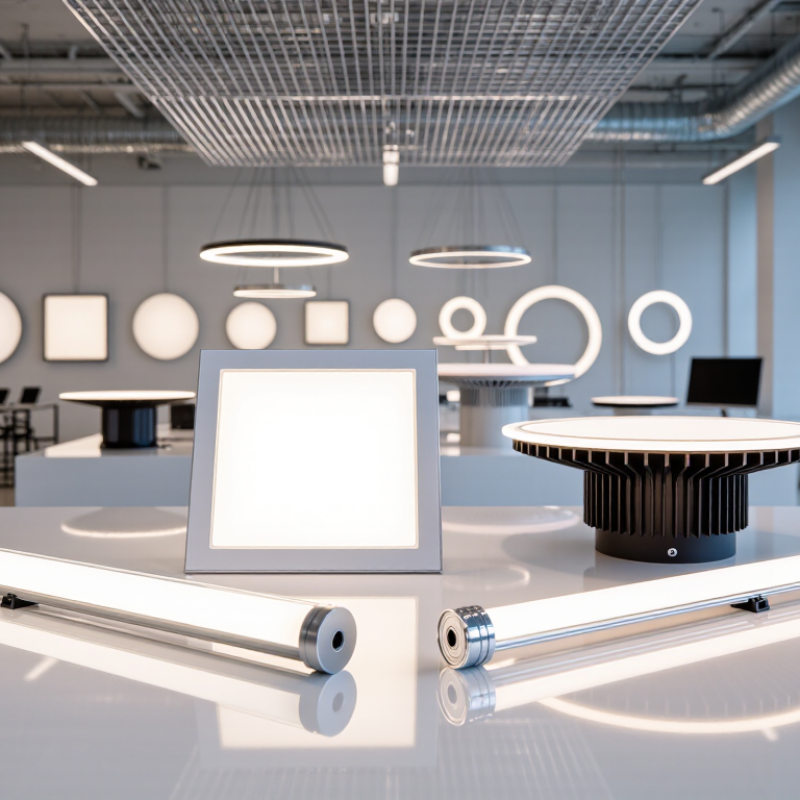
A leading commercial LED lighting manufacturer in China is defined by more than production capacity. Real experience appears in how engineers solve practical problems, such as glare above office desks, uneven warehouse illumination, or heat trapped inside narrow ceiling fixtures. A capable manufacturer studies the application before recommending wattage, beam angle, color temperature, and control methods. It should provide photometric files, samples, installation guidance, and clear performance data.
Quality must be visible and measurable. Reliable manufacturers use controlled processes for LED modules, drivers, thermal materials, and housing assembly. They test light output, color consistency, electrical safety, water resistance, and aging performance. Independent laboratory reports and recognized certifications strengthen credibility, but documents alone are not enough. Ask how samples are tested, how production batches are inspected, and how problems are recorded after delivery.
Communication also defines leadership. A professional team responds with accurate drawings, realistic lead times, and transparent technical limits. No factory is perfect. A supplier that admits design risks can be more dependable than one promising everything. I have found that small details often reveal maturity: readable labels, protective packaging, stable dimming, and replacement parts that remain available. Price matters, but a cheap fixture with early failures can disrupt an entire commercial project. The better manufacturer keeps improving, even when its current process already appears successful.
Key Product Categories and Commercial Lighting Solutions
China Best Commercial LED Lighting Manufacturers?
Commercial LED lighting starts with the right product category, not the brightest fixture. Common options include linear high bays, panel lights, troffers, downlights, track lights, floodlights, streetlights, and explosion-resistant industrial luminaires. Each serves a different space. A warehouse may need high-bay fixtures with wide beam angles, while a retail aisle benefits from adjustable track lighting and accurate color rendering.
The U.S. Department of Energy reports that LED lighting can use at least 75% less energy than incandescent lighting and last up to 25 times longer. These figures explain the demand for commercial retrofits. However, real savings depend on operating hours, controls, maintenance, and installation quality. A reliable manufacturer should provide photometric files, LM-79 performance testing, LM-80 data, flicker information, and clear warranty terms. Certificates alone are not enough.
Modern commercial lighting solutions combine fixtures with occupancy sensors, daylight dimming, emergency functions, and networked controls. The International Energy Agency continues to identify efficiency improvements as essential to reducing building energy demand. Still, connected systems can become unnecessarily complex. The difficult part is not finding more light. It is avoiding too much. In practice, a slightly lower output with better uniformity may improve comfort, reduce glare, and lower operating costs. Evaluation should include heat management, driver replacement, spare-part access, and measured performance after installation.
Manufacturing Standards, Certifications, and Quality Control
China’s commercial LED lighting manufacturers should be judged by documented processes, not attractive product photos. A reliable factory follows recognized electrical, photobiological, and electromagnetic safety standards. Certification requirements vary by destination market. CE, RoHS, FCC, and equivalent approvals may apply, while ISO 9001 supports consistent quality management.
Ask for complete test reports, not scanned certificates alone. Reports should identify the exact model, testing date, laboratory, and measured results. Useful evidence includes LM-79 photometric testing, TM-21 lifetime projections, thermal testing, ingress protection tests, and insulation checks. The numbers should match the production sample. Small differences can reveal weak document control.
Quality control must continue beyond final inspection. Incoming teams should check LED boards, drivers, aluminum housings, lenses, and wiring. During assembly, workers can verify torque, solder joints, polarity, and sealing. A finished fixture should undergo electrical safety testing, power measurement, dimming checks, and a short burn-in cycle. Keep serial records and sample photos.
Factory experience matters in difficult installations. A manufacturer that understands high ceilings, warehouses, retail displays, and harsh indoor environments can recommend suitable beam angles and thermal designs. Still, no process is flawless. I have seen acceptable prototypes fail after rushed production changes. Independent inspection remains worthwhile, especially for large orders. Clear corrective-action reports show whether a supplier learns from defects or simply replaces rejected units.
How to Evaluate Chinese LED Lighting Manufacturers
China Best Commercial LED Lighting Manufacturers?
Evaluating Chinese LED lighting manufacturers requires evidence, not attractive catalogs. The International Energy Agency reported that lighting represented about 15% of global electricity consumption before widespread efficiency improvements. This makes energy performance a procurement concern, not merely a design preference. Request LM-79 photometric reports, LM-80 LED testing, and TM-21 lifetime projections. Check whether reports match the exact LED package, driver, and fixture.
Factory experience matters. During an audit, inspect soldering lines, thermal testing, aging racks, and incoming component controls. Ask for production records from recent commercial orders. A serious manufacturer should explain lumen maintenance, color tolerance, surge protection, and driver failure rates clearly. Independent laboratories add credibility, especially when reports follow recognized IEC requirements. ISO 9001 certification helps, but certification alone proves little.
Compare samples under real conditions. Install them in a warehouse or retail aisle, then measure illuminance, glare, color consistency, and power draw. The U.S. Department of Energy notes that LED products can use at least 75% less energy than incandescent lighting and last much longer. Yet projected lifetime can be misunderstood. “50,000 hours” may describe lumen maintenance, not guaranteed operation. A weakness in my own evaluation is trusting test documents too quickly. Suppliers deserve verification, and buyers need a practical warranty process, spare-part access, and clear responsibility for failures.
China Best Commercial LED Lighting Manufacturers? - How to Evaluate Chinese LED Lighting Manufacturers
| Evaluation Dimension | What to Check | Practical Benchmark | Recommended Evidence | Suggested Weight |
|---|---|---|---|---|
| Product Performance | System efficacy, lumen output, beam distribution, CCT and color consistency | Commercial products commonly target approximately 100–180 lm/W, depending on fixture type and operating conditions | Independent photometric test report, IES/LDT files, LM-79 report and sample testing | 20% |
| LED Lifetime | Rated life, lumen maintenance, drive current, thermal design and failure-rate assumptions | Look for L70 claims supported by LM-80 and TM-21 data; lifetime should state operating temperature and test conditions | LM-80 test data, TM-21 projection, thermal test results and a clearly defined lifetime rating | 15% |
| Driver and Electrical Quality | Power factor, total harmonic distortion, surge protection, input-voltage range and driver availability | For many commercial applications, PF ≥0.90 and THD ≤20% are useful minimum screening levels; project codes may require stricter limits | Driver datasheet, electrical safety report, EMC report and test results at rated load | 15% |
| Safety and Compliance | Applicable electrical, photobiological, EMC and environmental requirements for the destination market | Documentation should match the exact model, rated input and target market rather than a similar product | Relevant IEC or regional test reports, declaration of conformity, factory quality records and traceable model numbers | 15% |
| Mechanical and Environmental Design | Ingress protection, impact resistance, corrosion protection, heat dissipation and installation method | IP65 or higher is commonly considered for dusty or wet commercial areas; IP and IK requirements depend on the application | IP/IK test reports, corrosion test information, material specifications and installation instructions | 10% |
| Quality Management | Incoming inspection, production controls, aging tests, calibration and corrective-action procedures | A documented quality system and consistent batch records are more valuable than an unverified quality claim | Quality-management certificate, inspection plan, sample inspection records and factory audit results | 10% |
| Customization Capability | Optics, housing, color temperature, controls, mounting options, labeling and packaging | The manufacturer should provide controlled drawings, revision management and a documented approval process for samples | Engineering drawings, bill of materials, sample approval record and change-control procedure | 5% |
| Warranty and After-Sales Support | Warranty duration, exclusions, replacement process, spare parts and technical response time | A written commercial warranty of 5 years is common for many professional LED products, subject to product and market conditions | Signed warranty terms, failure-handling procedure, spare-parts policy and service contact details | 5% |
| Total Cost of Ownership | Unit price, energy consumption, maintenance, installation, freight, duties and expected replacement costs | Compare delivered cost and projected operating cost over the project life, not purchase price alone | Formal quotation, energy calculation, logistics terms, maintenance assumptions and lifecycle-cost model | 5% |
| Total Evaluation Weight | 100% | |||
Note: Benchmarks are general screening references. Final requirements should be confirmed against the project specification, local regulations, applicable standards and the exact product configuration.
Major Applications and Buyer Selection Considerations
China Best Commercial LED Lighting Manufacturers?
Commercial LED fixtures serve offices, warehouses, retail stores, hospitals, parking areas, and outdoor facilities. The IEA reports that lighting uses about 15% of global electricity. The U.S. Department of Energy states that LED products can use at least 75% less energy than incandescent lighting. They can also last up to 25 times longer. However, real savings depend on controls, operating hours, and installation quality. A warehouse needs high-bay optics and occupancy sensors. A retail space may need accurate color rendering and adjustable beam angles. Healthcare areas require low flicker, stable output, and easy cleaning.
Buyers should request LM-79 photometric reports and LM-80 data for LED packages. TM-21 projections can support lumen-maintenance claims. Check delivered lumens, efficacy, power factor, and rated lifetime. Do not judge products by wattage alone. A brighter fixture can create glare and wasted energy. Review UGR values for offices, IP ratings for damp locations, and IK ratings for impact-prone areas. Color temperature also matters. Neutral white often suits offices, while warmer tones can support hospitality environments. Independent testing and recognized safety certifications strengthen supplier credibility. Yet paperwork is not performance. Sample testing, thermal checks, and a small pilot installation can expose problems before a full purchase. Even careful buyers sometimes overlook replacement access, software compatibility, or local warranty support. That oversight becomes expensive.
China Best Commercial LED Lighting Manufacturers? Major Applications and Buyer Selection Considerations
Commercial LED products are commonly used in offices, warehouses, retail spaces, roads, and outdoor areas. The chart compares representative midpoint efficacy values, measured in lumens per watt (lm/W), for typical commercial LED luminaires. Higher efficacy can reduce energy consumption, but buyers should also evaluate light distribution, color quality, thermal management, controls, warranty, certifications, and total cost of ownership.
Related Posts
-
What is the Best Type of Led Bulbs for Your Needs?
-
Best Commercial Lighting Solutions in China for Your Business?
-
Navigating the LED Bulb Market How to Identify Reliable Manufacturers for Your Procurement Needs
-

Advantages of Choosing LED Bulbs for Smart Lighting Solutions
-
China's Resilient Growth in LED Light Bulb Manufacturing Amidst US China Tariff Challenges
-
How to Choose the Right Exit Lights for Your Business Safety Needs