What Are Commercial LED Street Lights?
Commercial LED street lights are roadway luminaires that use light-emitting diodes to illuminate streets, intersections, parking areas, and public spaces. They typically combine LED modules, optical lenses, a heat-dissipating housing, and controls such as dimming or photocells. Their purpose is practical: provide useful nighttime visibility while managing energy use and maintenance needs.
The U.S. Department of Energy’s 2017 report, Adoption of Light-Emitting Diodes in Common Lighting Applications, describes substantial energy-saving potential from LED conversions, while noting that actual results depend on the application and installation. For a city, that distinction matters. A carefully aimed fixture can put light on a wet crosswalk instead of sending excess brightness toward nearby windows. But a poor design can still create glare. LEDs are not automatically better just because they are LEDs.
DOE solid-state-lighting specialist James Brodrick has emphasized the importance of evaluating lighting systems by their performance and energy savings, rather than by the light source alone. That is a useful lens for Commercial Led Street Lights: compare measured roadway illumination, power consumption, controls, and expected service life, not just wattage. The International Energy Agency also identifies efficient lighting as an important route to reducing electricity demand, though street-level outcomes vary by location and operating schedule.
Details matter. A quiet residential road may need different optics and dimming than a busy junction. Color appearance, pole spacing, maintenance access, and controls all shape the result. And there is a trade-off: brighter is not always safer. A responsible specification begins with the street itself, then tests the design against real conditions. That step is easy to underestimate.
Definition and Purpose of Commercial LED Street Lights
What Are Commercial LED Street Lights?
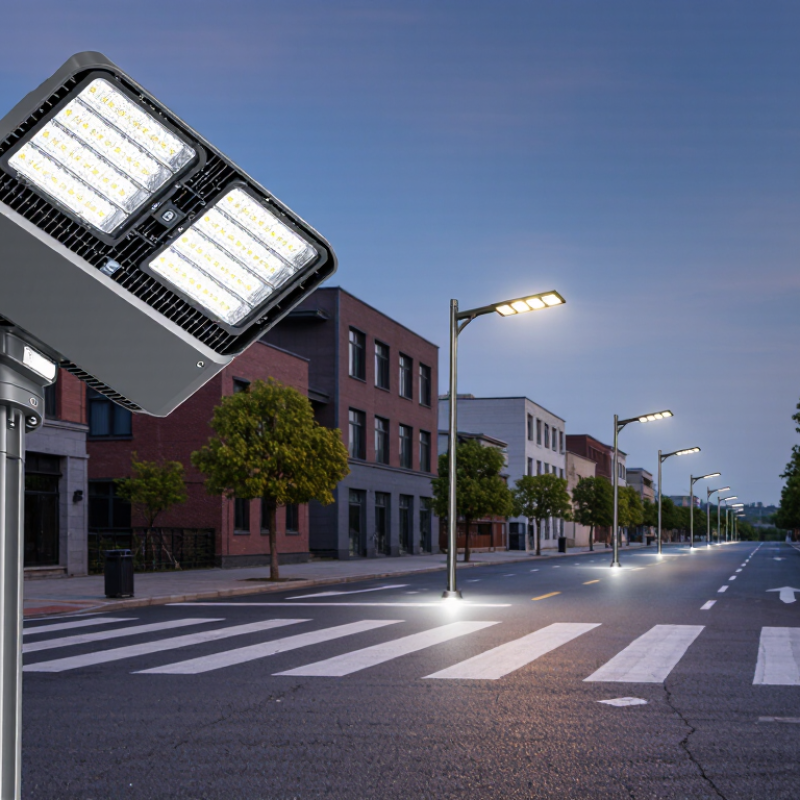
Commercial LED street lights are outdoor lighting fixtures designed for roads, parking areas, campuses, industrial sites, and public pathways. They use light-emitting diodes to produce focused illumination with less energy than many older lighting technologies. Their purpose is practical: improve nighttime visibility, support safer movement, and reduce operating costs for property owners and municipalities. A typical fixture includes an LED module, heat-management housing, optical lens, mounting arm, and electrical driver. These parts work together under rain, dust, vibration, and changing temperatures.
Proper selection requires more than checking brightness. Light distribution should match the road width and mounting height. Excessive brightness can create glare, dark contrasts, and discomfort for drivers or pedestrians. In field assessments, poorly aimed fixtures often waste light on walls, windows, or empty ground. That detail matters. A reliable project considers color temperature, ingress protection, electrical compatibility, maintenance access, and local lighting requirements. Photometric testing and installation records also help verify performance. Still, energy estimates can be imperfect when operating schedules, weather, and cleaning conditions change.
Tips: Measure the site before choosing a fixture. Review the photometric layout, not only the lumen rating. Keep poles, trees, and nearby windows in the assessment. Use qualified professionals for wiring and installation. Inspect fixtures periodically for dirt, flicker, loose connections, or unusual heat. A lower purchase price may look attractive, but poor optics or difficult maintenance can increase long-term costs.
How Commercial LED Street Lights Produce and Direct Light
What Are Commercial LED Street Lights?
Commercial LED street lights create light through semiconductor diodes. When electrical current passes through each diode, electrons release energy as visible photons. A driver controls this current and helps maintain steady output during voltage changes. Heat sinks then move excess heat away from the LED components, protecting performance over time.
How Commercial LED Street Lights Produce and Direct Light
Producing light is only half the job. Optical lenses, reflectors, and the fixture shape direct photons toward roads, sidewalks, and parking areas. A carefully designed beam can spread light across several lanes without wasting much energy above the horizon. Engineers review mounting height, pole spacing, road width, and pavement reflectance before selecting a distribution pattern. In field installations, small angle changes can create dark patches or unwanted glare. No layout is perfect. Weather, dust, aging lenses, and tree growth can change results, so real measurements still matter.
Tips: Check uniformity, not brightness alone. Ask for photometric data and confirm the intended beam pattern. Keep lenses clean, inspect wiring, and review light levels after installation. I would also question overly optimistic energy claims, because local conditions can reduce actual savings. A practical trial area often reveals problems that drawings miss.
Key Components and Performance Characteristics
Commercial LED street lights are outdoor lighting systems designed for roads, intersections, parking areas, and public paths. Their key components include LED chips, a heat sink, optical lenses, a driver, housing, and mounting hardware. Unlike older lamps, LEDs direct light more precisely and waste less energy as heat. In practical inspections, I look for even pavement brightness, secure wiring, and clean light distribution. A powerful fixture is not always the best fixture. Poor optical control can create glare, dark patches, or discomfort for drivers.
Tips: Check the driver’s operating range and protection rating. Ask for tested lumen output, not only chip wattage. Inspect the housing for corrosion resistance and drainage. Confirm that the mounting angle matches the road design. Small details matter.
Performance depends on more than initial brightness. Important characteristics include luminous efficacy, color temperature, color rendering, lifetime, surge protection, dimming control, and thermal stability. A reliable fixture should maintain consistent output during hot afternoons and freezing nights. Its optical pattern should place light across the lane without shining into nearby windows. In my experience, thermal management is often underestimated. A compact housing may look neat, but trapped heat can reduce long-term performance. Maintenance access also matters, because difficult repairs increase labor time and may leave dark sections on the road. Evaluation should combine laboratory data, installation conditions, and realistic maintenance planning.
Factors That Shape Street Light Selection and Installation
What Are Commercial LED Street Lights?
Factors That Shape Street Light Selection and Installation
Commercial LED street lights are outdoor fixtures designed for roads, parking areas, campuses, and industrial access routes. Their selection should begin with the site, not the wattage. Road width, traffic speed, pole spacing, mounting height, and nearby homes all affect the required light distribution.
A proper photometric study shows where illumination will fall. It can also reveal dark gaps, excessive brightness, and glare toward drivers or windows. In practice, wet pavement often changes visual performance. A layout that looks excellent on a computer may feel harsher during rain. That difference deserves attention. Color temperature, shielding, dimming capability, and uniformity should match the environment. Lower energy use matters, but poor visibility creates a costly compromise.
Installation conditions shape long-term reliability. Crews should inspect pole strength, wiring, grounding, drainage, and available maintenance access before ordering fixtures. Surge protection and suitable ingress protection are important in exposed locations. Local electrical requirements and roadway standards must guide the work. Controls may reduce output during quiet hours, yet they need careful commissioning. A missed setting can leave an area too dark.
Budget decisions also require restraint. The lowest purchase price may hide difficult repairs or frequent cleaning. A higher-quality housing can protect internal components from moisture, dust, and heat. Still, “premium” does not automatically mean suitable. Each project needs verified performance data, realistic maintenance planning, and an honest review of previous mistakes. Even experienced teams sometimes overlook tree growth or future road changes. That oversight can reshape the lighting plan within a few years.
What Are Commercial LED Street Lights?
Annual Energy Use by Rated Power
This chart shows the calculated annual electricity use of one LED street light operating for 12 hours per day over 365 days. Higher-wattage fixtures generally deliver more light, but final selection also depends on road classification, mounting height, pole spacing, optical distribution, glare control, environmental protection, dimming, and local lighting requirements.
Calculation: annual energy use = rated power × 12 hours × 365 days ÷ 1,000. Values represent one fixture and exclude control-system losses.