top of page

How to Choose Prison Ceiling Downlights in 2026

Choosing a Prison Ceiling Downlight in 2026 means balancing safe visibility, durability, energy use, and practical maintenance. The fixture must illuminate faces, floor edges, and doorways without creating deep shadows or harsh glare. It also needs a sealed, impact-resistant design suited to frequent cleaning and demanding operating conditions. Small details matter: lens retention, fastener access, and how a failed unit can be replaced.

Energy performance is part of that decision. The U.S. Department of Energy’s Energy Saver guidance says LED products use at least 75% less energy and last up to 25 times longer than incandescent lighting. Those figures are broad comparisons, not prison-specific guarantees; actual savings depend on controls, operating hours, and the existing installation. Lighting researcher Dr. Mariana Figueiro has described light as “a powerful drug,” a useful reminder that illumination affects people, not just surfaces. Her work is not a correctional fixture specification, though. That distinction matters.

A sound selection process should compare photometric files, color rendering, glare control, ingress protection, impact performance, and documented testing. Ask suppliers for evidence, not just product claims. Then check the proposed layout in the actual ceiling and room conditions. Even a technically compliant downlight can disappoint when spacing, mounting height, or wall reflectance is overlooked. The uncomfortable truth: there is no universal fixture that solves every site’s needs. That is worth admitting before procurement.
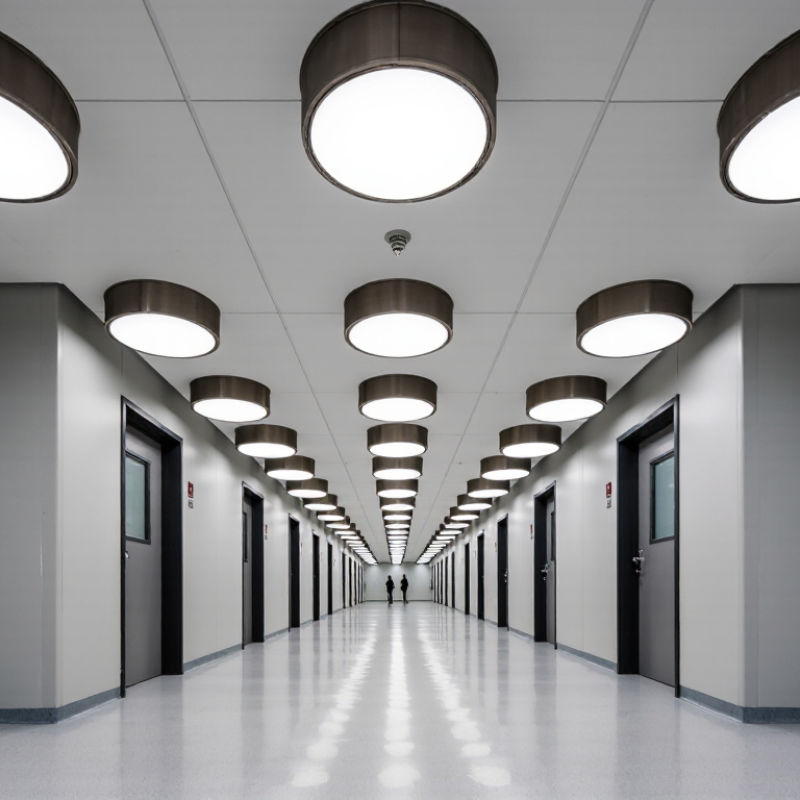
How to Choose Prison Ceiling Downlights in 2026

Assessing Prison Ceiling Conditions and Security Requirements

A prison ceiling is not a neutral mounting surface. Inspect slab height, moisture, dust, existing cable routes, and access points before selecting a downlight. In cells and corridors, recessed fittings should sit flush, resist impact, and avoid exposed edges or loose components. Specify sealed, impact-resistant housings where cleaning, condensation, or tampering is a concern. Check service access too. A fitting that is secure but difficult to maintain can create avoidable disruption.

Light distribution matters as much as fixture strength. Review uniformity at floor level and on faces, doors, and work surfaces; deep shadows can undermine routine observation. The Illuminating Engineering Society’s RP-7-21 guidance treats illuminance as task-specific, so use its recommendations alongside a site survey rather than applying one lux target everywhere. Small details matter. Mock up a fitting in the actual ceiling when possible, then inspect glare from standing and seated positions.

Energy figures need context. The U.S. Department of Energy’s 2020 U.S. Lighting Market Characterization estimated that lighting used about 208 terawatt-hours of electricity nationwide in 2020; that figure is not prison-specific. It supports checking connected load and controls, but not cutting light levels blindly. Document ceiling condition, measured illuminance, glare, ingress protection, and maintenance access. I would still question any specification based only on a catalogue image.

Defining Lighting Levels, Beam Patterns, and Color Temperature

How to Choose Prison Ceiling Downlights in 2026
Defining Lighting Levels, Beam Patterns, and Color Temperature

Set lighting levels by task, not by fixture wattage. EN 12464-1:2021 lists 100 lux for workplace circulation areas and 500 lux for reading and writing tasks. These are useful reference points, not prison-specific requirements. Measure maintained light on floors, desks, and faces, then account for dirt, ageing, and shadows. Check uniformity, too. A bright patch beside a dark doorway can make visual checks harder.

Beam shape matters as much as output. A narrow beam can create harsh pools on a cell floor; a wide, controlled distribution usually suits corridors and shared rooms better. Specify shielding to limit glare from beds and seated positions. Mock up one ceiling bay before ordering. It may reveal awkward shadows that drawings miss.

Choose color temperature for the room’s use, then verify it on site. A neutral 3500–4000 K appearance can support visual tasks, while warmer light may feel less stark in rest areas; neither range guarantees comfort. CCT alone says little about color fidelity or glare. The CIE 2019 position statement recommends daytime light reaching the eye at 250 lux melanopic EDI, with much lower levels in the evening and night. This is health guidance, not a prison lighting rule. Measure at eye level. Some assumptions will need revisiting after installation.

How to Choose Prison Ceiling Downlights in 2026 - Defining Lighting Levels, Beam Patterns, and Color Temperature

The illuminance figures below are practical planning ranges, not universal legal requirements. Confirm final values, emergency-lighting provisions, and product requirements against applicable local codes, security policies, and a project-specific lighting design.

Area or design factor Planning guidance Beam pattern and placement Color and visual quality Selection notes
Cells and sleeping areas About 100–200 lx maintained on the general horizontal task plane; provide separately controlled brighter task lighting where required. A broad, uniform distribution—often approximately 90°–120°—can help limit harsh pools of light. Check vertical illumination and shadows at doors and observation points. Typically 3000–4000 K; CRI (Ra) of 80 or higher is a useful general target. Coordinate light output and switching with privacy, observation, nighttime operation, and resident well-being requirements.
Cell corridors and circulation routes About 100–200 lx maintained on the floor, with appropriate vertical illumination for faces, doors, and signs. Use overlapping distributions along the route; a medium or wide beam, often around 60°–100°, may suit ceiling height and spacing. Check for dark gaps and glare at viewing angles. 3000–4000 K; Ra ≥ 80 is a practical target where accurate visual recognition matters. Assess uniformity and viewing conditions from both ends of the corridor, not only directly beneath each fitting.
Control rooms and staff work areas About 300–500 lx maintained on desks or other visual task surfaces, subject to the task and applicable workplace guidance. Broad, even distribution—commonly around 60°–100°—helps reduce distracting bright spots. Check screen reflections and task-specific vertical lighting. Usually 3500–4000 K; Ra ≥ 80, with higher color rendering considered where color discrimination is important. Consider dimming and separate task controls where operational needs allow; verify glare and reflected images at actual workstation positions.
Interview, consultation, and examination rooms About 300–500 lx maintained for general or face-to-face tasks; examination tasks may require additional local lighting. A medium-wide distribution, roughly 60°–100°, can balance general coverage and visual comfort. Avoid strong shadows on faces and work surfaces. 3500–4000 K; Ra ≥ 80 is a reasonable general target. Confirm the needs of staff, occupants, cameras, and any clinical tasks; select controls and luminaires to suit the room’s security requirements.
Showers, washrooms, and other wet areas About 150–300 lx maintained on relevant surfaces; assess face lighting at mirrors separately where applicable. A wide beam can support general coverage; check shadows, wet-surface reflections, and the location of mirrors and partitions. 3000–4000 K; Ra ≥ 80 is a useful general target. Choose ingress protection based on the actual water and dust exposure and applicable electrical rules. Specify sealed, cleanable construction where needed.
Beam angle and spacing Do not choose by beam angle alone; confirm maintained illuminance and uniformity with photometric calculations for the room geometry. Narrow beams (about 15°–40°) concentrate light; medium beams (about 40°–60°) suit more focused coverage; wide beams (about 60°–120°) spread light over larger areas. Actual beam definitions vary by product. Choose CCT for the space’s visual tasks and operational policy, and check that all fittings in a shared view have consistent color appearance. Spacing depends on mounting height, beam distribution, surface reflectance, and required uniformity; use manufacturer photometric files in a lighting calculation.
Security, durability, and maintenance Design for maintained—not initial—illuminance, allowing for depreciation, dirt, and the planned cleaning and replacement schedule. Select a distribution that avoids unlit areas and minimizes troublesome glare; confirm the complete installed assembly is suitable for the ceiling and environment. Specify CCT and color rendering consistently across the project; verify product performance data rather than relying on appearance alone. Where required by the facility, specify secure, impact-resistant, tamper-resistant, and anti-ligature construction. Confirm these properties through project security requirements and product documentation.
Emergency lighting Set levels, duration, and coverage in accordance with the applicable local emergency-lighting code and facility life-safety plan. Verify coverage of escape routes, exits, changes of direction, and other locations identified by the applicable design requirements. Follow local requirements for emergency operation and any specified color or identification features. Emergency function, testing, power supply, and monitoring must be designed and verified separately where required; normal-lighting values do not establish emergency compliance.

Selecting Durable, Tamper-Resistant Downlight Materials

How to Choose Prison Ceiling Downlights in 2026

In secure facilities, downlight materials must withstand repeated cleaning, impact, and close inspection. Start with the bezel and housing. Stainless steel offers strong corrosion resistance, but performance depends on grade, finish, and cleaning chemicals. Coated die-cast aluminum can reduce weight, though chipped coatings may expose vulnerable edges. Check the product’s test documentation, not just a “heavy-duty” label.

Small details matter. A flush, low-profile bezel leaves fewer edges to grip or pry. Look for concealed, securely retained fasteners and a housing designed to resist tampering after installation. For the lens, impact-resistant polycarbonate is often more suitable than ordinary glass, but it can scratch or discolor over time. Ask how the lens is retained and whether it can be inspected without damaging the fitting. A tough lens is only as reliable as its fixing.

Match materials to the actual room. A washroom needs better protection from moisture and cleaning agents than a dry corridor. Confirm the specified ingress rating and chemical compatibility with the maintenance team. Finish samples can help reveal glare, visible scratches, and cleaning marks under real lighting. I would not assume the most expensive metal is automatically the safest choice; installation quality and routine inspection matter too. Small compromises are easy to miss on a specification sheet.

Checking Safety Standards, Controls, and Installation Compatibility

How to Choose Prison Ceiling Downlights in 2026

Prison downlights must withstand tampering, frequent cleaning, and demanding maintenance conditions. Check the facility specification and applicable electrical codes before comparing products. Ask for documented impact-resistance testing, secure fasteners, and a lens that resists removal from the occupied space. Confirm whether UL 1598 or other required luminaire certifications apply; emergency fixtures may also need UL 924 certification. Requirements vary by project, so verify them with the facility’s electrical engineer. A rating alone is not a complete safety plan.

Controls and installation details matter just as much. Confirm whether the driver works with the site’s dimming protocol, such as 0–10 V, and test emergency operation separately. Measure ceiling depth, cutout size, conduit entry, and access above the ceiling before ordering. The U.S. Department of Energy’s Energy Saver guidance says LEDs use at least 75% less energy than incandescent lighting. That comparison does not predict savings against every existing fixture, though. A checklist can still miss a tight plenum or awkward service access; inspect a mock-up when possible.

Tips: Match control wiring to the installed system, not just the product sheet. Photograph the ceiling cavity and record fixture dimensions before procurement. A small mismatch can slow installation.

Comparing Maintenance Needs and Total Lifecycle Costs

How to Choose Prison Ceiling Downlights in 2026

Comparing Maintenance Needs and Total Lifecycle Costs

A low purchase price can hide expensive maintenance. In secure facilities, replacing a ceiling downlight may require staff time, controlled access, and temporary room restrictions. Include those costs alongside energy use and parts when comparing options. The U.S. Department of Energy’s Federal Energy Management Program says LED products can use at least 75% less energy and last up to 25 times longer than incandescent lighting. That is a broad technology comparison, not a guaranteed service life for a particular fixture. Ask suppliers for rated life, lumen-maintenance data, driver replacement details, and test conditions. Check that the figures match the actual operating temperature and daily switching pattern.

Look beyond the first invoice. A sealed, impact-resistant housing may cost more, but can reduce cleaning, damage, and call-outs. Compare the cost of replacement drivers, compatible lenses, labor, and any access equipment over the planned service period. A fixture that saves energy but needs frequent specialist repairs may not deliver the lowest lifecycle cost. The assumptions matter. Keep them visible in the bid review.

bottom of page