China Top 10 Commercial Lighting Manufacturers
Choosing a Commercial Lighting manufacturer is not just a matter of comparing product photos or headline prices. A warehouse aisle, hotel lobby, and office meeting room each place different demands on light quality, controls, installation, and maintenance. This guide introduces ten manufacturers associated with China’s commercial lighting sector and offers a practical starting point for closer research. A shortlist is useful. It is not a final verdict.
The comparison considers factors buyers can investigate: product range, stated technical specifications, customization options, quality-control information, warranty terms, and after-sales support. Details matter. For example, a fixture’s lumen output and beam angle affect how evenly a shop floor is lit, while glare and color consistency can change the feel of a showroom. Dimming compatibility and access to replacement drivers may also influence long-term operating costs. These points should be checked against current product documents and project requirements, not assumed from a catalog.
No single manufacturer will suit every project. Company capabilities, product lines, and export services can change, and published specifications do not always reveal how a product performs after installation. That deserves reflection. Buyers should request recent test reports, samples where practical, and clear answers about lead times, spare parts, and warranty coverage. They should also confirm that products meet the standards required in their destination market. The manufacturers featured here are best treated as candidates for due diligence, rather than an automatic endorsement. A careful comparison can help purchasers ask sharper questions and choose lighting that fits the space, budget, and maintenance plan.
Commercial Lighting Manufacturing in China: Scope and Product Categories
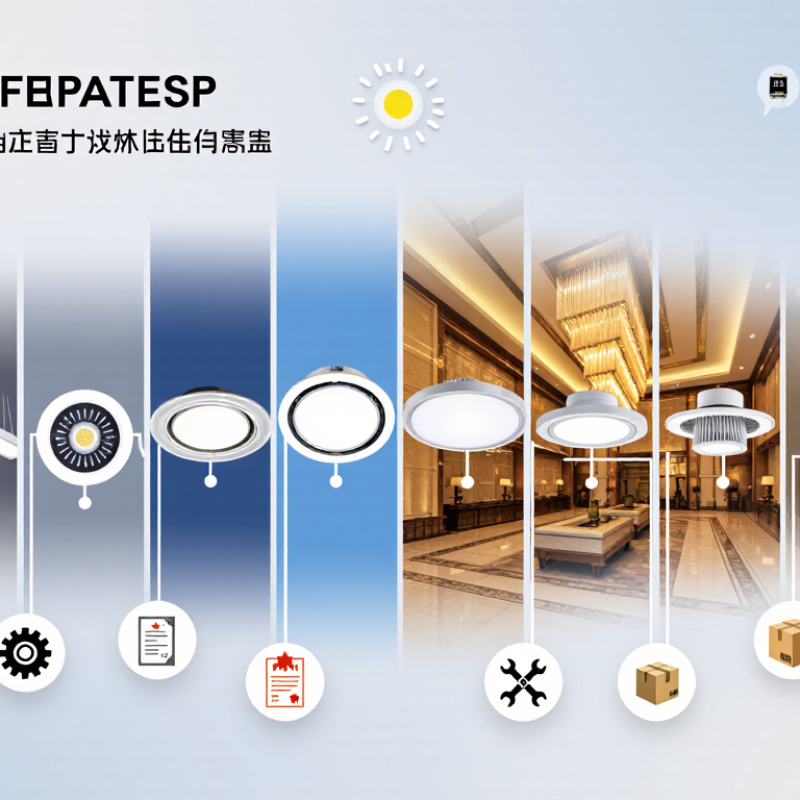
Commercial lighting manufacturing in China covers more than assembling fixtures. It includes optical design, thermal management, driver integration, housing production, testing, and packaging. Products serve offices, retail stores, warehouses, factories, hotels, and outdoor commercial spaces. Each setting creates different demands. A high-bay fixture above a warehouse aisle needs controlled glare and dependable heat dissipation. A recessed office panel needs even light across desks and meeting tables.
Common product categories include LED downlights, panel lights, track lights, linear fixtures, high-bay lights, floodlights, and street or area lights. Manufacturers may also offer emergency lighting and customizable systems with sensors or dimming controls. Specifications matter: check lumen output, color temperature, color rendering, beam angle, ingress protection, and rated lifetime. Ask how figures were measured. Details matter. Published values alone may not show performance in a real installation, and quality can vary between product lines.
Tips: Match the fixture to the mounting height and task, not just the room name. Request test reports, sample units, and clear installation instructions before placing a large order. Compare driver quality and warranty terms, too. A sample may look excellent on a workbench, yet reveal glare or uneven color once installed. That gap deserves a second look.
Criteria for Identifying and Comparing the Top 10 Manufacturers
A credible comparison starts with testable performance, not catalogue claims. Ask for independent photometric reports showing efficacy, lumen output, color consistency, glare control, and performance at operating temperature.
The U.S. Department of Energy’s Energy Saver guidance says LED products use at least 75% less energy and can last up to 25 times longer than incandescent lighting. That is a useful technology benchmark, not a guarantee for every commercial fixture. Check the exact luminaire, test conditions, and documented lifetime assumptions.
Reliability deserves equal weight. Review thermal-management details, driver specifications, surge protection, warranty terms, and sample aging-test records. Request evidence against relevant IEC 60598 requirements and confirm that reports match the model being quoted.
Good paperwork matters. For controls, test dimming and sensor response in a real room; a brief demonstration may reveal flicker or delayed switching that a datasheet misses.
Compare lead times, spare-part availability, customization limits, and quality-control records across several production batches. A low unit price can hide costly replacement risks.
No scorecard is perfect: project conditions vary, and published lifetime estimates rarely capture every installation. Record unanswered questions, then weigh verified evidence more heavily than polished claims.
Profiles of Ten Leading Chinese Commercial Lighting Manufacturers
Profiles of ten leading Chinese commercial lighting manufacturers are most useful when they reveal engineering choices, not just catalog breadth. Compare office, retail, warehouse, and outdoor products separately. A 120-centimeter linear fixture above a checkout counter faces different glare and maintenance demands than a high-bay unit in a dusty warehouse. Details matter.
There is a clear energy context. The Global Alliance for Buildings and Construction’s 2023 Global Status Report estimates that buildings used 34% of global energy demand and generated 37% of energy- and process-related CO₂ emissions in 2022. These figures cover buildings broadly, not lighting alone. They support asking manufacturers for measured efficacy, dimming performance, lifetime assumptions, and test conditions. A headline lumen-per-watt figure is not a project guarantee.
Across the ten profiles, look for optical design capability, thermal testing, driver compatibility, controls integration, and documented quality checks. Request photometric files and test reports, then compare products under consistent conditions. Some manufacturers may suit custom runs; others may be better for standardized, high-volume orders. Not always obvious. Public information rarely makes factory-to-factory comparisons easy, and “long life” claims need context, including ambient temperature and operating hours. That caveat belongs in any serious profile.
Key Technologies, Certifications, and Commercial Applications
A useful comparison of the top 10 commercial lighting manufacturers should look beyond lumen output. Check efficacy, color rendering, and whether the stated color temperature suits the space. A shop may need accurate product colors, while a warehouse needs clear visibility across tall aisles. Optics matter, too: narrow beams can leave dark patches between shelves.
Thermal design affects long-term performance. Ask for LM-80 data and related lifetime projections, then check warranty terms against the intended operating hours. Heat tells the truth. Flicker performance and dimming compatibility deserve attention in offices and classrooms. Controls such as occupancy sensors and daylight response can reduce wasted energy, but only when commissioned correctly.
Certifications should match the destination market and installation type. Review product safety and electromagnetic compatibility documents, plus IP or IK ratings where moisture or impact is a concern. Do not treat a logo as proof; confirm the certificate covers the exact model. Applications also change the specification: food areas, parking structures, and healthcare rooms have different demands. I would still question any comparison that ranks manufacturers using one efficiency figure alone. Real project conditions are messier.
China Top 10 Commercial Lighting Manufacturers - Key Technologies, Certifications, and Commercial Applications
Industry overview of ten common commercial-lighting product categories and capabilities associated with manufacturers in China. The rows are not company profiles or a verified ranking. Certification and regulatory requirements depend on the specific product, destination market, and intended use.
| No. | Manufacturer capability / product category | Key technologies | Relevant certifications and standards | Typical commercial applications |
|---|---|---|---|---|
| 1 | LED downlights and recessed spotlights | LED modules, optical reflectors or lenses, thermal management, dimming options, and selectable color temperatures. | Product safety may be assessed to applicable luminaire standards such as IEC 60598. CE marking and RoHS compliance may apply for products placed on the EU market; CCC requirements depend on the product category. | Offices, hotels, retail stores, corridors, and reception areas. |
| 2 | LED panel lights | Edge-lit or back-lit LED layouts, light guides or diffusers, glare control, and drivers supporting common dimming methods. | Applicable luminaire safety and electromagnetic-compatibility requirements vary by market. Photobiological safety may be evaluated using IEC 62471 where relevant. | Offices, classrooms, healthcare support areas, and other spaces with suspended or recessed ceilings. |
| 3 | Linear and continuous-row lighting | Modular LED boards, continuous-row connectors, optical lenses, and controls for zoning or daylight response. | IEC 60598 may be relevant to luminaire safety. For connected or networked systems, radio-equipment and EMC requirements may also apply in the destination market. | Open-plan offices, supermarkets, warehouses, schools, and production areas. |
| 4 | LED track and accent lighting | Directional optics, adjustable heads, track adapters, and dimming for highlighting merchandise or architectural features. | Safety assessment is product-specific; applicable IEC 60598 parts and local electrical requirements should be checked. CE marking is a market-access requirement where applicable, not a standalone quality rating. | Retail displays, galleries, showrooms, restaurants, and hospitality interiors. |
| 5 | High-bay and low-bay luminaires | High-output LED arrays, heat sinks, beam-angle options, and sensor-compatible drivers for large or high-ceiling spaces. | Ingress-protection ratings are classified under IEC 60529; impact-protection ratings may use IEC 62262. These ratings describe protection levels and are not, by themselves, product certifications. | Factories, logistics centers, workshops, and indoor sports facilities. |
| 6 | LED floodlights and area lights | Wide or asymmetric beam optics, outdoor-rated enclosures, surge-protection options, and corrosion-resistant finishes. | Outdoor suitability may involve IEC 60598 requirements and specified IP ratings under IEC 60529. Electrical and EMC requirements depend on the destination market and installation. | Building façades, loading areas, parking lots, yards, and perimeter lighting. |
| 7 | Street and roadway luminaires | Roadway optics, pole-mounting systems, dimmable drivers, and controls designed for scheduled or adaptive operation. | Photometric performance is commonly evaluated against project specifications and relevant roadway-lighting standards. Local electrical, EMC, and environmental requirements must be verified for each market. | Roads, campuses, industrial estates, public spaces, and large private developments. |
| 8 | Emergency and exit lighting | Emergency battery packs, self-test functions, maintained or non-maintained operation, and illuminated exit signs. | Emergency-lighting products must meet the fire, building, and emergency-lighting rules applicable at the installation site. Requirements differ substantially by country and building type. | Commercial buildings, hotels, shopping centers, offices, and public venues along escape routes. |
| 9 | Cleanroom and hygienic-area luminaires | Sealed housings, smooth surfaces, low-particle design, cleanable materials, and controlled light output. | Ingress-protection claims should be tied to test results and the relevant IEC 60529 classification. Cleanroom suitability also depends on project-specific hygiene, installation, and cleaning requirements. | Laboratories, pharmaceutical production areas, food-processing facilities, and medical support spaces. |
| 10 | Smart lighting controls and connected systems | Occupancy and daylight sensors, dimming, scheduling, scene control, and wired or wireless communication interfaces. | Controls may require EMC and radio-equipment compliance in the target market. ISO 9001 concerns an organization's quality-management system; it does not certify the performance of an individual luminaire. | Offices, hotels, campuses, retail environments, and buildings seeking centralized energy management. |
How to Evaluate Chinese Commercial Lighting Suppliers
China Top 10 Commercial Lighting Manufacturers
How to Evaluate Chinese Commercial Lighting Suppliers
Choosing a commercial lighting supplier takes more than comparing unit prices. Request a specification sheet covering lumen output, color temperature, beam angle, driver details, and rated service life. Check whether the supplier can explain how these figures were measured. A bright sample in a showroom may look convincing, but it cannot show how a fixture performs after months of daily use.
Tips: Ask for a working sample and test it in a space similar to your project. Confirm the quoted model matches the sample, including housing, finish, and driver. Request recent quality inspection records and clarify how defects are handled. Details matter.
Assess production capacity through specific questions, not broad promises. Ask about lead times for your order size, packaging methods, and how changes are recorded. Review product test reports and confirm they apply to the exact model you plan to buy. If possible, speak with previous commercial customers about consistency between sample and delivery. A tidy document set is useful, though it does not guarantee a smooth project. I would also note response times and unanswered questions; small delays can reveal a communication problem, but one slow reply is not proof. Compare several suppliers using the same checklist before making a decision.
Related Posts
-
Exploring LED Panel Light Innovations at the 138th China Import and Export Fair 2025
-
What is Led Street Lights and How Do They Work?
-
How to Choose the Best Panel Lights for Your Home Lighting Needs
-

Why Choose Light Panels for Your Business Needs?
-
The Rise of Smart Commercial Lighting Solutions Transforming Workspaces
-
How to Choose the Best Commercial Emergency Lights for Your Business Needs

