top of page

2026 Top Portable Light Strip Suppliers Buyers Guide

The 2026 Top Portable Light Strip Suppliers Buyers Guide examines a fast-changing category shaped by flexible LEDs, compact batteries, USB-C charging, and app-based controls. Portable Light Strip products now appear in photography kits, retail displays, vehicles, bedrooms, outdoor shelters, and emergency work areas. Buyers need more than attractive colors. They need measurable brightness, stable color, safe charging, durable housings, and dependable supplier support.

Grand View Research reports continued expansion in the global LED lighting market, driven by energy efficiency, smart controls, and declining component costs. MarketsandMarkets also identifies connected lighting and flexible form factors as important growth areas. However, these reports usually combine portable strips with broader LED categories. The data is useful, but not perfectly specific. That limitation deserves attention.

Performance matters.

A credible supplier should disclose lumens per meter, color-rendering index, color temperature, battery capacity, runtime, ingress protection, and operating temperature. Buyers should also inspect connector quality, adhesive performance, bend radius, and replacement-part availability. A bright strip can still disappoint when heat builds under a tight coil. A polished app cannot repair weak solder joints.

Lighting researcher Mariana Figueiro states, “Light is the most powerful synchronizer of the circadian system.” Her observation reminds buyers that color temperature and nighttime brightness affect more than appearance. This guide compares supplier experience, testing practices, customization ability, certifications, warranty terms, and delivery reliability. It also questions common assumptions. Some specifications look impressive on paper. Real rooms are less forgiving.
2026 Top Portable Light Strip Suppliers Buyers Guide

Portable Light Strips: Definition, Features, and Common Applications

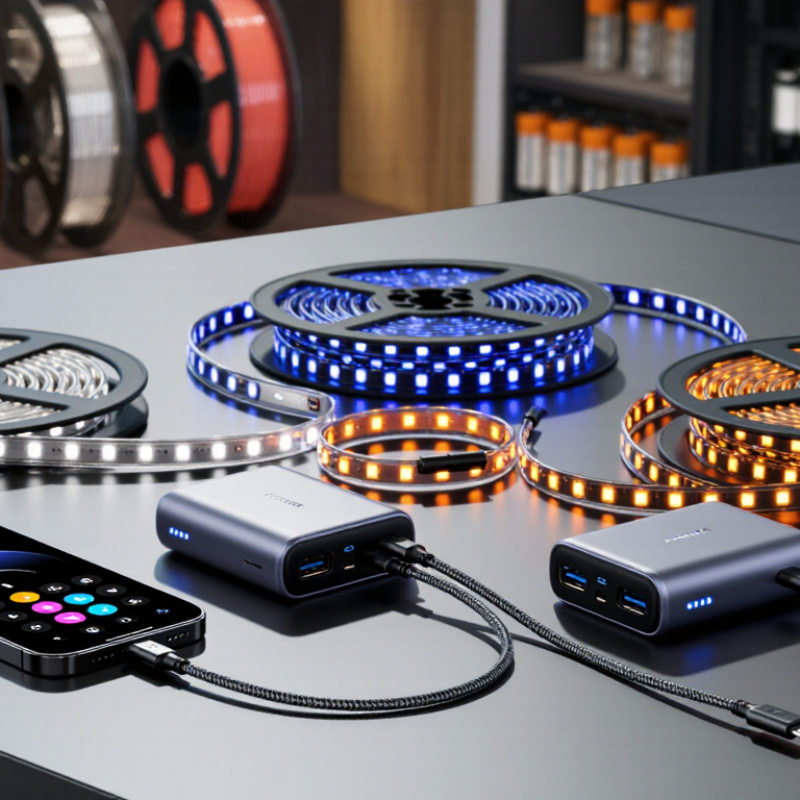
Portable light strips are flexible LED lighting units designed for movement and quick installation. They usually combine a compact strip, rechargeable battery, controller, and low-voltage power system. Unlike fixed lighting, they can illuminate shelves, work surfaces, displays, vehicles, or temporary rooms without permanent wiring.

Useful features include dimming, adjustable color temperature, magnetic mounting, adhesive backing, and USB charging. Some models resist dust and light splashes, but protection levels vary. In practical testing, battery life often changes with brightness and temperature. A strip rated for ten hours may last less during continuous high-output use. It is bright enough for accents, but not always suitable as the only work light. That distinction matters.

Tips: Check battery capacity, charging time, strip length, and heat control before buying. Press the mounting surface clean and dry. Test the controller before installation. For kitchens, workshops, or outdoor displays, review the stated protection rating carefully. I also recommend checking connector strength, because repeated bending can loosen weak joints. Not every portable strip performs equally. A short trial under real conditions can reveal glare, uneven brightness, or disappointing runtime.

2026 Portable Light Strips: Typical Power Density by Strip Type

Portable light strips are commonly selected by LED format, brightness, flexibility, and battery demand. The chart shows representative nominal power ratings per meter for widely used strip configurations.

Typical specifications: 3528 single-color strips are often rated around 4.8 W/m, COB strips around 8 W/m, high-density white strips around 12 W/m, and 5050 RGB strips around 14.4 W/m. Actual consumption varies by LED density, color, brightness, and operating voltage.

Key Factors for Evaluating Portable Light Strip Suppliers

2026 Top Portable Light Strip Suppliers Buyers Guide

When evaluating portable light strip suppliers, test more than brightness. Grand View Research reports that the global LED lighting market is expected to grow strongly through 2030, increasing supplier competition and product variation. Ask for measured lumen output, color-rendering index, battery capacity, and runtime at the same brightness level. A strip claiming 1,000 lumens may achieve that result only briefly. Request laboratory reports, batch records, and samples from current production.

Battery reliability deserves careful attention. The International Energy Agency identifies continued growth in battery demand, but capacity claims still vary widely between suppliers. Check charging cycles, thermal protection, connector strength, and protection against overcharging. For outdoor use, verify the tested IP rating, not only the printed label. A sealed controller can still fail when its cable entry is weak. I have seen specifications look excellent while the adhesive detached from a slightly dusty surface. That detail is easy to miss.

Tips:

Compare three samples under identical conditions. Measure runtime with a timer, inspect solder joints under bright light, and bend the strip repeatedly near the connector. Confirm minimum order quantity, production lead time, spare-part availability, warranty handling, and traceability before signing. UL Solutions notes that testing consistency matters for lighting safety, yet supplier documents may not reveal every weakness. Treat certificates as evidence, not proof of perfect performance. A short pilot order often exposes more than a polished presentation.

Major Supplier Types and Product Selection Criteria

Portable light strip suppliers usually fall into four groups: manufacturers, distributors, OEM/ODM workshops, and lighting specialists. Manufacturers often provide better control over LED density, housing design, and production schedules. Distributors can offer faster delivery and mixed inventory for smaller projects. OEM/ODM suppliers support custom lengths, connectors, colors, and packaging, but their minimum order quantities may be higher. Lighting specialists are useful when installations require detailed optical or electrical guidance.

Product selection should begin with the application, not the catalog photograph. Check brightness in lumens per meter, color rendering, color temperature, and power consumption. For kitchens, workshops, and display cases, stable output matters more than impressive peak brightness. Measure the installation area carefully. A small length error can create visible dark sections. Choose the correct protection rating for dust or moisture, and verify whether the adhesive suits painted walls, metal, or glass. Battery models also need realistic runtime tests, not only advertised capacity.

Ask suppliers for samples, test reports, wiring diagrams, warranty terms, and replacement procedures. Confirm connector compatibility before approving a large order. During product checks, I have found that heat buildup often appears after several hours, not during a short demonstration. This is easy to miss. Suppliers should explain LED binning, controller limits, and quality inspection records in plain language. I would also compare three samples under the same camera and power supply. Small color differences become obvious then, although this method is not perfect. Availability can change without warning, so confirm lead times in writing before production planning.

2026 Top Portable Light Strip Suppliers Buyers Guide - Major Supplier Types and Product Selection Criteria

Supplier Type Typical Product Offering Typical Order Profile Main Advantages Key Limitations Best Buyer Fit
OEM/ODM Lighting Manufacturer Rechargeable LED strips, custom lengths, private-label packaging, customized controls and housings Medium to high volume; sample approval and production lead time are normally required Customization, production control, scalable pricing and technical support Higher minimum order quantities, tooling requirements and longer development cycles Retailers, importers, project buyers and private-label sellers
Wholesale Distributor Standard portable strips, power banks, USB charging cables, controllers and replacement parts Small to medium volume; stock-based purchasing Shorter delivery times, mixed-SKU purchasing and easier replenishment Less customization and potentially higher unit cost than direct manufacturing Electrical wholesalers, local retailers and maintenance contractors
Specialty LED Supplier High-CRI strips, flexible silicone products, task lighting and application-specific portable systems Low to medium volume; specification-driven purchasing Better technical documentation, optical consistency and application guidance Narrower product range and higher prices for specialized specifications Photography, retail display, hospitality and professional installation users
General Export Supplier Common USB, battery-powered and decorative LED strip products with standard accessories Small to medium trial orders; specifications vary by listing Broad selection, competitive quotes and flexible product combinations Variable quality control, documentation, battery configuration and after-sales support Buyers comparing multiple designs before committing to a larger order
Custom Lighting Integrator Complete portable lighting assemblies, mounting systems, controls and installation services Project-based; quantities depend on site requirements System design, installation coordination and integrated technical responsibility Higher project cost and less suitability for simple off-the-shelf purchases Events, exhibitions, architectural displays and commercial installations

Portable Light Strip Product Selection Criteria

Selection Dimension Recommended Specification or Range Why It Matters Buyer Verification Method
LED Technology SMD LED strip with evenly spaced diodes; COB construction for a continuous dot-free appearance Determines light uniformity, appearance and heat distribution Request LED density, strip construction details and a powered sample
Operating Voltage 5 V USB for compact use; 12 V or 24 V systems for longer or higher-output installations Must match the battery pack, adapter, controller and strip design Check the product label, connector polarity and measured input voltage
Power Consumption Compare watts per metre and total system wattage; include controller and conversion losses Controls battery size, heat generation, runtime and operating cost Request a rated watts-per-metre value and verify it under normal operation
Brightness Specify measured lumens per metre or illuminance at a defined distance instead of relying only on LED count LED quantity alone does not accurately indicate useful light output Request photometric data and compare samples using the same power and diffuser conditions
Color Temperature Warm white: approximately 2700–3000 K; neutral white: approximately 3500–4500 K; cool white: approximately 5000–6500 K Affects atmosphere, visibility and color perception Confirm the nominal CCT and inspect a powered sample for visual consistency
Color Rendering Index CRI 80 or higher for general lighting; CRI 90 or higher for displays, photography and color-sensitive work Higher CRI generally produces more natural-looking colors Request a test report showing Ra and, where relevant, R9 performance
Ingress Protection IP20 for dry indoor use; IP65 for dust protection and water jets; IP67 for temporary immersion when properly sealed Protects the strip from dust and moisture in the intended environment Verify the complete assembly rating, including connectors, controller and battery enclosure
Battery and Runtime Specify battery chemistry, capacity in Wh, charging method and runtime at a stated brightness level Runtime changes significantly with brightness, strip length and battery age Use the formula: approximate runtime in hours = battery watt-hours ÷ system watts
Charging Interface USB-C is preferred for modern portable products; confirm input rating and charging protection Improves compatibility, charging convenience and replacement options Check charging voltage, current, cable type and overcharge protection documentation
Control Method Inline switch, remote control, Bluetooth or app control; dimming should be smooth and flicker-free Determines usability, installation flexibility and user experience Test pairing, control range, dimming steps and recovery after power interruption
Cutting and Connection Cut only at marked cut points; confirm cut interval, connector type and maximum continuous length Incorrect cutting or excessive length can cause open circuits, voltage drop or uneven brightness Review the installation guide and test the shortest and longest intended configurations
Flexibility and Mounting Flexible PCB or silicone-jacket construction with suitable clips, channels or adhesive backing Affects installation reliability, bend radius and service life Check the minimum bend radius, surface compatibility and adhesive performance after cleaning
Thermal Management Use an aluminium profile or heat-conductive mounting surface for higher-output strips Excess heat accelerates LED depreciation and can shorten component life Measure surface temperature during a continuous operating test
Safety and Compliance Require applicable electrical, battery, electromagnetic compatibility and material documentation for the destination market Supports legal sale, safer operation and smoother customs clearance Request current test reports, declarations, battery transport documents and product labels
Quality and Supply Capability Use documented tolerances for CCT, brightness, battery capacity, color consistency and defect rate Reduces variation between samples, production batches and replacement units Approve a golden sample, define acceptance criteria and use pre-shipment inspection for volume orders

Buyer Guide to Pricing, Quality, Compliance, and Customization

Portable light strip sourcing in 2026 demands more than a low unit price. Buyers should compare landed cost, not factory quotation alone. Add batteries, chargers, packaging, inspection, freight, import duties, and replacement risk. Ask for tiered pricing at 500, 2,000, and 10,000 units. Cheap quotes can mislead. Samples should match production materials, or the comparison becomes weak.

Quality starts with measurable specifications. Request lumen output, color temperature tolerance, CRI, LED density, bend radius, battery capacity, charging time, and runtime at stated brightness. Check the strip after repeated bending and charging. Inspect solder joints, connector strength, adhesive performance, and heat behavior. IP ratings need test evidence, especially for outdoor use. A glossy sample can hide poor thermal design. Evidence matters.

Compliance must fit the destination market. Request current electrical safety, electromagnetic compatibility, chemical restriction, battery transport, and recycling documentation. Verify that reports identify the exact model, battery, adapter, and factory. Generic certificates create uncertainty. Customization may include length, controls, firmware, colors, packaging, and logo placement. Define tooling ownership and file rights in writing. Set approval samples, change-control rules, warranty terms, and response times. The first specification is rarely perfect. A reliable supplier welcomes audits, traceable test records, and controlled pilot production.

Ordering, Testing, and Managing Portable Light Strip Supply Chains

Ordering portable light strips requires more than comparing unit prices. The International Energy Agency’s 2024 Energy Efficiency Market Report places global efficiency investment above USD 600 billion in 2023. This pressure encourages buyers to verify real performance, not marketing claims. Request samples with identical battery cells, LED density, connector types, and packaging. Specify lumen output, color temperature, runtime, charging cycles, and operating temperature before purchase.

Test every shipment under repeatable conditions. Measure brightness after 30 minutes, not immediately after switching on. Check adhesive strength on painted metal, plastic, and fabric. Inspect solder joints, cable strain relief, charging ports, and waterproof seals. The U.S. Department of Energy’s solid-state lighting research shows thermal management strongly affects LED performance and lifetime. A warm strip can look bright today, then fade early.

Supply-chain control needs simple evidence. Keep batch photographs, test records, carton counts, and retained samples. Use incoming inspection, not trust alone. Portable products often fail through small details, such as loose connectors or weak magnets. IEC lighting standards can guide electrical and photobiological safety checks, while independent laboratories provide stronger verification. Forecasting should include seasonal demand and battery lead times. My imperfect lesson: the cheapest approved sample may still hide inconsistent production. Re-test after scale-up. Supplier audits should examine process discipline, not only showroom quality.

bottom of page